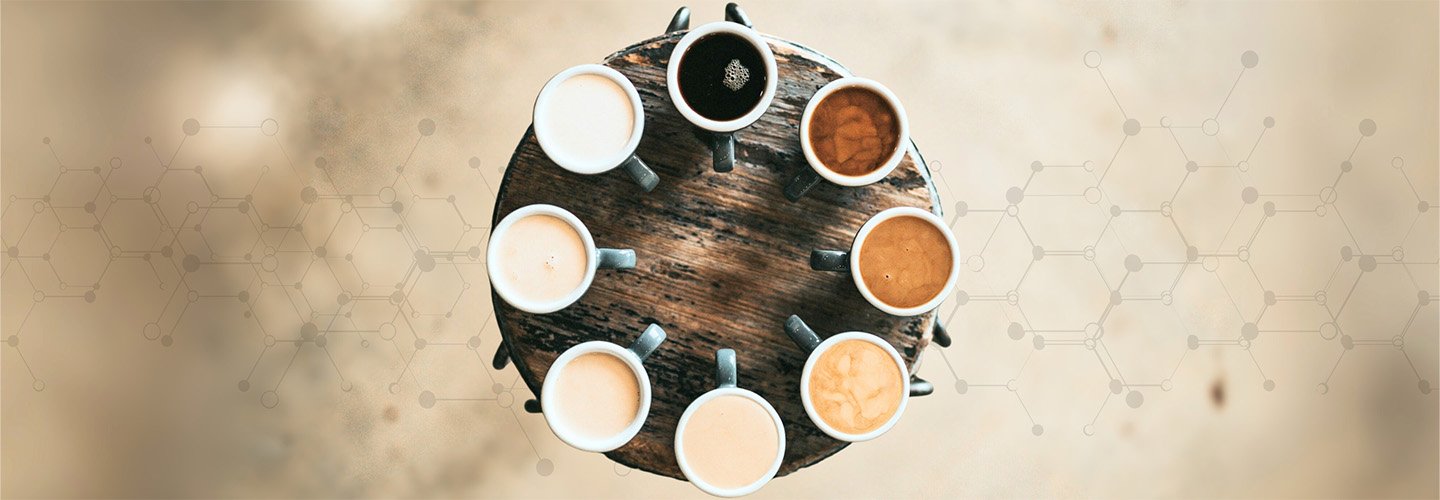
Two Indians, a Finn, a Brit, and a Trinidadian, walk into a meeting… It’s not the beginning of a joke but a window into the world of Aspidistra, a team that lives diversity. Our discussions on Diversity, Equity, Inclusion, and Accessibility (DEIA) aren’t theoretical; they stem from research and our lived experiences. These conversations reinforce the role diversity plays in enriching our professional and personal lives.
From a behavioural science perspective, we all use shortcuts to understand the world and interact with people. Sadly, it’s natural to have preconceptions, prejudices and notions that vary depending on our backgrounds. These shortcuts can sometimes feed irrational fears of the unfamiliar and prevent us from embracing unknown perspectives embodied in people who are very different from us.
Another fear lurks in the background—the fear of failure. However, in corporate life especially, we can try to overcome this fear by reframing it as an opportunity to learn and do better next time. In striving for success, it’s crucial to embrace diverse perspectives. By fostering inclusivity, we mitigate the risk of inadvertently excluding any group.
While many DEIA efforts focus on awareness, the approach assumes that if people know better, they’ll do better. However, most actions are driven by subconscious reactions, not conscious decisions. Therefore, focusing only on awareness isn’t effective. Companies should consider changing policies, practices, motivations, and environments to create impactful change.
Evolving expectations in DEIA
“There is now more visibility and higher expectations around DEI. Companies recognise that failing publicly in this area is unacceptable, a shift from the attitudes of 5-10 years ago,” says Laura Smith, a DEI strategist and founder of VALIDEI–an Aspidistra network partner that coordinates research teams across Europe to support socially responsible businesses.
This increased scrutiny can also have drawbacks. “Companies can be less willing to share their DEI challenges and progress due to fear of negative perceptions. This lack of transparency leads to repeated mistakes, as organisations don’t learn from each other’s experiences. They assume that simply trying harder within their existing frameworks will yield better results.”
For example, companies tend to stick to what’s convenient rather than expanding their search pools or changing their recruitment or retention strategies. Laura notes, “I encountered a company doing business in Africa that claimed they couldn’t find any qualified Black candidates for a senior role despite the continent’s vast talent pool of Black professionals. They were actively recruiting through their connections, but without expanding their networks, it was like fishing in a pond where the desired fish just don’t exist.”
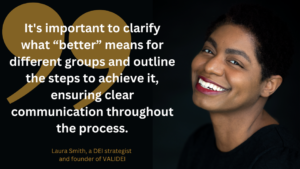
Another common misstep is a heavy focus on diversity without adequately addressing equity and inclusion. As Laura explains, “Diversity involves the different kinds of people within an organisation; equity concerns fairness in structures, support, and compensation; and inclusion pertains to people’s experiences. Shifting our focus to equity and inclusion can help retain the diversity that companies desire.”
Furthermore, we must resist the urge to tokenise people by merely showcasing a select few as representatives of diversity within our organisations. It is tempting to wave a fig leaf that helps declare, “We are diverse!” But as Smith notes, diversity is just the beginning; the real breakthrough lies in ensuring we can create inclusive environments where everyone can thrive and provide equitable opportunities for all.
Breaking through the nordic “birch ceiling”
In the Nordics, the concept of diversity has evolved beyond gender balance to include individuals from diverse ethnicities, backgrounds, ages, racial groups, and those with unique intersectional experiences. Consider the distinct insights a middle-aged, Asian, neurodivergent, immigrant mother might contribute.
Adding “A” for Accessibility to the DEIA framework is pivotal. Guaranteeing equal access—be it physical, digital, or mental health-related—is a fundamental step towards providing equal opportunities within an organisation.
For instance, should a person of colour newly employed by a Finnish company expect to ascend to the management team or board? If a “birch ceiling” hinders such progress, then the journey towards true equity remains incomplete. It’s imperative to recognise and dismantle these barriers to cultivate an environment where equity and accessibility can flourish.
DEIA: A business imperative
Diversity is not just a moral imperative; it’s a business necessity. Is your company pursuing DEIA initiatives as a mere business requirement, or is it genuinely committed to transforming into a more inclusive and equitable environment? Do your diverse hires have the same opportunities as everyone else?
Businesses must reflect diversity to engage effectively with customers, clients, and partners. The effort has been proven to yield substantial rewards:
- Financial performance: Diverse workforces perform better financially (McKinsey 2019).
- Innovation and creativity: Teams with varied perspectives develop more innovative and creative solutions (Harvard Business Review 2018).
- Employee engagement: Employees who feel valued and respected are more engaged and productive (Glassdoor 2020).
- Talent acquisition: Top talent increasingly seeks employers committed to DEI (Deloitte 2021).
At Aspidistra, we are committed to breaking barriers and fostering an environment where everyone can thrive. We don’t just talk about diversity; we live it, understand it, and practise it every day. It’s hard work, and there are no easy fixes, but we are seeing the tangible value of expanding our personal and professional worldviews. And by doing so, we are creating opportunities and experiences that would otherwise only be possible in our dreams.
By embracing diversity in all its forms and championing equity, inclusion, and accessibility, we can build a stronger, more innovative, and more inclusive future.
Written by Wall Denise & Asa Butcher