
Social wellbeing is increasingly being seen as an essential pillar of public health, alongside physical and mental health. Yet, many companies fail to prioritise it. HR professionals are burdened with administrative tasks, and many lack the bandwidth to focus on social health initiatives.
Compounding this issue, budgets are being trimmed, and employees are being asked to do more with less, making it even harder to justify investments in workplace connection and community. Yet, social health is about creating close bonds with others and represents a fundamental biological need akin to food.
Laura Smith, organizational researcher and founder of VALIDEI, emphasises this point: “When companies ask for increased productivity, they need to ensure that employees have the internal resources, such as mental health support, well-being initiatives and social connections, to sustain that demand. Without these, they’re essentially trying to squeeze water from a dry sponge.”
How employers can foster social health
The concept of social health gained currency before the socially isolating COVID-19 pandemic and has accelerated since then. Lockdown protocols that aimed to prevent the spread of the disease caused many social connections to be lost.
The resulting loneliness epidemic, or crisis, as some believe, is being driven by several trends. These include digitalisation, with its fleeting online versus real-life connections and parasocial relationships, the rise of remote work, urbanisation, and the growing emphasis on individualism over community. Other factors include declining membership in churches and clubs, fewer marriages and an increase in single-person households.
With the average person spending roughly one-third of their entire life at work, the workplace is a logical place to help tackle the loneliness gap (the difference between the social connections we have and the ones we want to have). Employers have the ideal opportunity to help teams find and build connections with the help of internal programs or with the support of external vendors and entrepreneurs.
Laura Smith points out that, “Employers must recognise that they aren’t just hiring resources; they’re hiring people with comprehensive social needs, and the work environment is an opportunity to provide or support solutions for that.”
Employers can promote activities and initiatives that teach relational skills and ensure that occupational health services screen for isolation and related depression during health visits. Studies have shown that people who volunteer tend to live longer lives, so employers can contribute to their employees’ social well-being while having a positive impact on their communities by allowing teams to carve out space in their working lives for volunteerism that aligns with the company’s priorities.
However, volunteer programs must be structured properly to avoid exploitation. Laura Smith warns, “Make certain that volunteering is not an avenue for exploitation. If disproportionately expected from marginalised individuals, such as immigrants, the unemployed or retirees, unpaid service can reinforce inequalities rather than provide meaningful benefits when relevant rewards are not understood or realized. Companies should ensure both in-house and external volunteering will be a genuine growth opportunity rather than an unpaid obligation.”
The long-term benefits of social health initiatives
Employers who invest in social health can take strategic steps to foster a more connected and engaged workforce. Simple initiatives, such as providing larger communal spaces, allowing time for casual conversations after meetings or sharing citywide events that cater to various demographics, can significantly enhance employees’ sense of belonging.
Team activities such as walking groups, cooking or sports and drawing classes, and book clubs all foster connection and provide fertile soil for companionship and new friendships to flourish.
Employers will also need to figure out how to extend social health support to increasingly distributed working teams. The challenge will be easier to manage for on-site and hybrid teams but will require more ingenuity for fully remote professionals, who may require even more support to build meaningful connections in the workplace.
Even if it’s not feasible to provide these resources in-house, employers can support employees by collecting information about publicly available programmes and posting it on company notice boards, whether physical or digital.
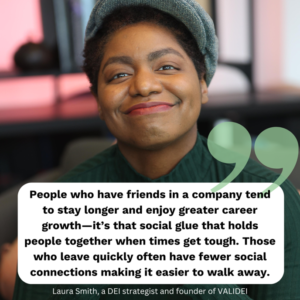
As Laura Smith puts it, “Social bonds serve as glue during challenging times. Employees with strong workplace friendships are more likely to remain longer and progress in their careers. On the other hand, employees who depart quickly often lack significant workplace connections.”
Ultimately, social health is a strategic factor in employee engagement, retention and organisational success—it is not just a nice-to-have.
By Denise Wall and Asa Butcher